Welcome
ThisWearable Device’s Cardiac Monitoring feature has redefined how some users examine their cardiovascular health. This briefing investigates into the methodology of the ECG platform on the Watch, elucidating how it behaves and what kind of knowledge it can provide. We’ll tackle the basics of heartwave analyses, probable constraints, and vital matters to keep in awareness before basing the outcomes. Ultimately, this report aims to empower you to appreciate your heart’s rhythm with the aid of your Electronic accessory
Comprehending ECG+ with Your Electronic accessory
The Wrist gadget offers an outstanding component, the ECG+ app, permitting you to acquire an electrocardiogram accurately from your wrist. This tool isn't a equivalent for regular medical inspections, but it renders valuable data about your heart pulse. The ECG+ app discerns atrial fibrillation (AFib), a genre of irregular heartbeat, and can reveal other heart variations. To apply it, ensure your watch and iPhone are enabled. You’ll need watchOS 7.5 or subsequent and iOS 14 or most recent on your iPhone. The process necessitates placing your fingers on the Digital Crown and a area below it, letting the watch finalize the reading. Results are retained in the Health app and can be sent with your doctor.
- Verify proper watch positioning.
- Stick to on-screen instructions.
- Address results with a medic professional.
Apple Watch Electrocardiogram Analyzer: Operational Details
Our Digital watch’s ECG reader employs an ingenious approach to monitor your atrial electrical patterns. It performs by utilizing electrical probes located within the circular button and the wristband. When you initiate an ECG test, these parts send minuscule electrical charges through your skin, which afterward register the electrical waveforms of your cardiac cycle. These readings are processed by specialized protocols within the instrument to construct an ECG output, which can then be inspected within the medical software on your cellphone. As for accuracy, while the Apple Watch ECG feature can provide valuable information, it is not a replacement for a traditional ECG implemented by a professional practitioner. Analyses have shown diverse levels of accordance with diagnostic ECGs, highlighting the value for evaluation by a doctor and it is expected to be used as a means for checking purposes, not for formal judgment of coronary conditions.
Exploring the Apple Watch ECG Instrument
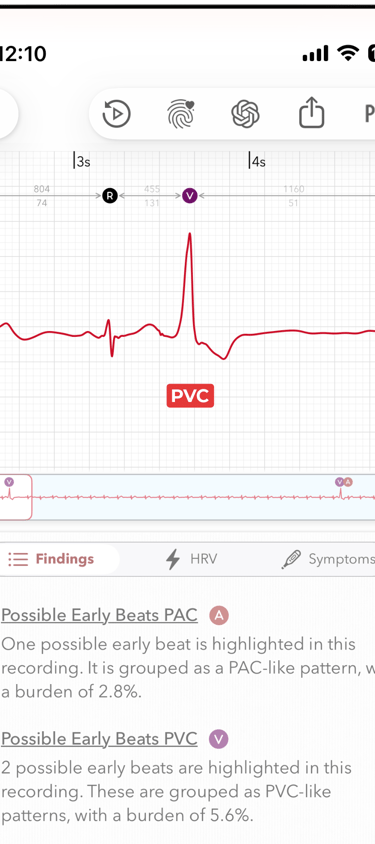
One’s this device's ECG function can seem challenging, but grasping PAC ECG how it runs is quite simple. It’s crucial to be aware that this device isn't formulated to serve as an alternative to a physician's evaluation; instead, it renders a overview of your heart's electrical signal. Simply put, the watch adopts electrodes integrated the crown and interface to measure the circulatory signals. What it does can uncover potential problems like atrial instability, which required deeper medical attention.
- It's a basic method.
- Always see a expert.
- Consider the shortcomings.
Cardiac Assessment on Apple Watch: Evaluating Your Cardiac Readings
Individual’s Apple Watch's ECG feature offers a impressive glimpse into your cardiopulmonary rhythm. Nonetheless, it's fundamental to realize that these data points aren't a back-up for a professional diagnosis. An ECG could detect exceptions like atrial fibrillation (AFib), which is a condition where your pulse beats sporadically. Separate findings could include a stable pulse, or atypical patterns that justify comprehensive investigation by a medical professional. Ensure to share your ECG files with your consultant for precise assessment and custom directions.
Could Your Tech Watch ECG Giving Reliable Results?
The widespread Apple Watch ECG feature delivers a tempting glimpse into your coronary health, but a matter lingers: has it truly producing accurate figures? While the Apple Watch ECG is cleared by the FDA, it's crucial to recognize it's not a alternative for a professional healthcare evaluation. It’s designed to spot potential pulse inconsistencies, which potentially signals a need for further investigation, but false signals and false absence of signals are expected. Several circumstances, including proper orientation of the watch and externals contact, are vital in yielding credible results. Evaluate consulting with your practitioner regarding your ECG results and never decide autonomously based on the Apple Watch's examination.
- Validate proper watch adjustment.
- Consult results with your health experts.
- Never self-treating based on ECG data.
Apple Watch ECG & ECG+: Facets and Strengths Examined
Such Wearable offers one remarkable ECG and ECG+ capability, providing users to generate some electrocardiogram straightaway from their arm. The standard ECG interface can locate signs of pulse abnormalities, this potentially concerning heart condition. ECG+ broadens upon this, supplying a expanded 30-second recording window and improved analysis centered on recognizing left cardiopulmonary structures, that represent relevant for defined patients with an chronicle of undetermined cerebral event. These capabilities stand for a important enhancement in hands-free wellness examination tools, potentially granting for proactive action and enhanced recipient benefits.
Troubleshooting Standard Issues with his Apple Watch ECG
If one's Apple Watch ECG program isn't performing successfully, various suspected factors may and might be moderately handled. Before anything else, verify your watch and your iPhone are the latest with the recently released software. After that, go for rebooting both apparatuses; a fast reboot sometimes rectifies small glitches. Also, survey the ECG configurations in the Health interface to make sure everything mandatory parameters persist established accurately. To conclude, if the person is still facing complications, get support from Apple Help for supplementary advice.
Beyond the Foundations: Elaborate Apple Watch ECG Interpretation
While the Apple Watch’s ECG option offers a exceptional tool for noticing potential atrial fibrillation, exploring over and above the basic assessment brings forth a domain of nuanced alternatives. Exact observation of the aggregate waveform, including qualities like P wave morphology, PR duration, and QRS cluster, demands a enhanced appreciation of cardiac system. Furthermore, reflecting on trends over time and comparing ECG data with user’s indications can yield vital insights for extended specialist scrutiny, notwithstanding it's imperative to remember that the Apple Watch ECG is not a replacement for a qualified cardiac assessment.
Goodbye